 ultimate-guide
What Is Direct Store Delivery? A Complete Guide
Last Updated: October 27, 2026
Quick Summary
Direct store delivery is a distribution model in which a supplier delivers products straight to retail store shelves, skipping the regional warehouse. A route driver visits each store to stock product, rotate older inventory, and often handle the sales relationship at the same time. It is most common for fast-moving goods such as snacks, bread, and beverages.
- The supplier's route driver controls shelf execution and can fix gaps the same day.
- The five-stage DSD cycle runs from order capture through proof of delivery.
- DSD suits perishable, fast-moving products sold across many stores per route.
- Suppliers carry the cost of trucks, drivers, and route labor on every stop.
- A hybrid model often works, with DSD for top-velocity stores and a distributor for the rest.
Table of Contents
- What Direct Store Delivery Means and How It Works
- The Supplier-to-Store Delivery Flow
- Which Products and Industries Use Direct Store Delivery
- Direct Store Delivery Examples in Beverage, Snack, and Bakery Sales
- Direct Store Delivery Advantages and Disadvantages for Suppliers and Retailers
- Direct Store Delivery vs Warehouse Distribution and Third-Party Distribution
- Direct Store Delivery Software and Tools for Route Management
- Planning Your Next Step Into a Direct Store Delivery Route Role
- Frequently Asked Questions
What Direct Store Delivery Means and How It Works
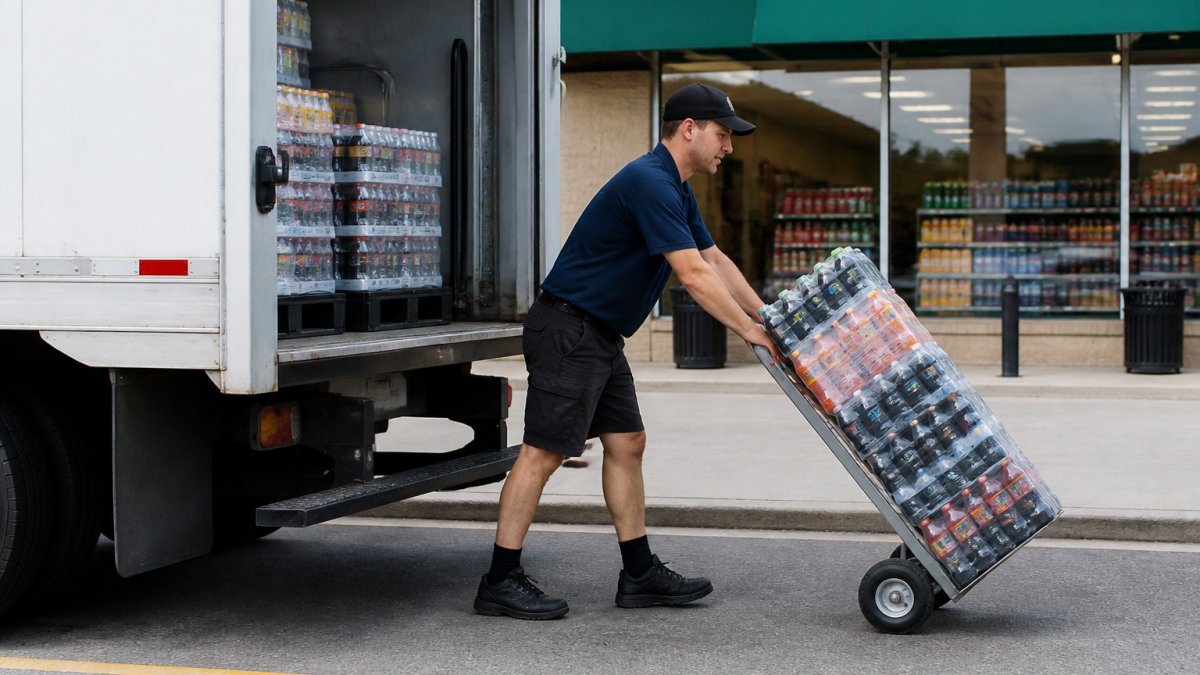
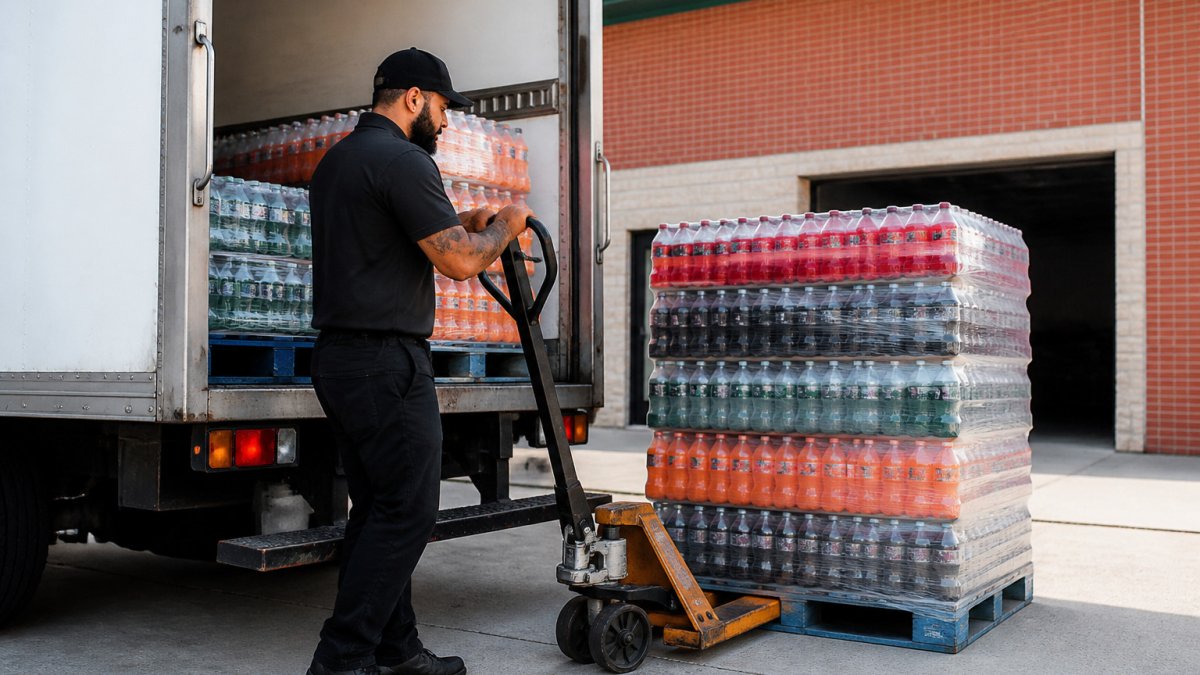
Direct store delivery, usually shortened to DSD, is a distribution model in which a manufacturer or supplier delivers products straight to retail store shelves, skipping the regional warehouse. Instead of a truck carrying pallets to a distribution center that later ships to stores, a route driver visits each store, stocks product, rotates older inventory, and often handles the sales relationship at the same time. DSD-style routes are most common for fast-moving goods that need frequent replenishment, such as snacks, bread, and beverages.
The model matters because it changes who controls the shelf. Under a traditional warehouse model, the retailer's buyer places an order and the product sits in a distributor's inventory until it ships. Under direct store delivery, the supplier's representative sees the shelf directly, catches gaps, and fixes them the same day.
The direct store delivery model is best understood as a trade-off between control and cost. Suppliers take on the expense of trucks, drivers, and route labor.
The Supplier-to-Store Delivery Flow
A typical DSD cycle follows a repeatable sequence:
- Order capture: Orders come from store-level reorders, a route sales representative's visit, or an automated replenishment system.
- Route planning: Stops are sequenced so the truck covers its territory efficiently within driver hours.
- Loading and dispatch: Product is loaded in delivery order so the first stop unloads first.
- In-store delivery: The driver brings product into the store, rotates stock, removes expired items, and restocks the shelf.
- Proof of delivery: The store signs off, typically on a handheld device, and payment or credit terms are recorded.
Route Sales Representatives and In-Store Merchandising
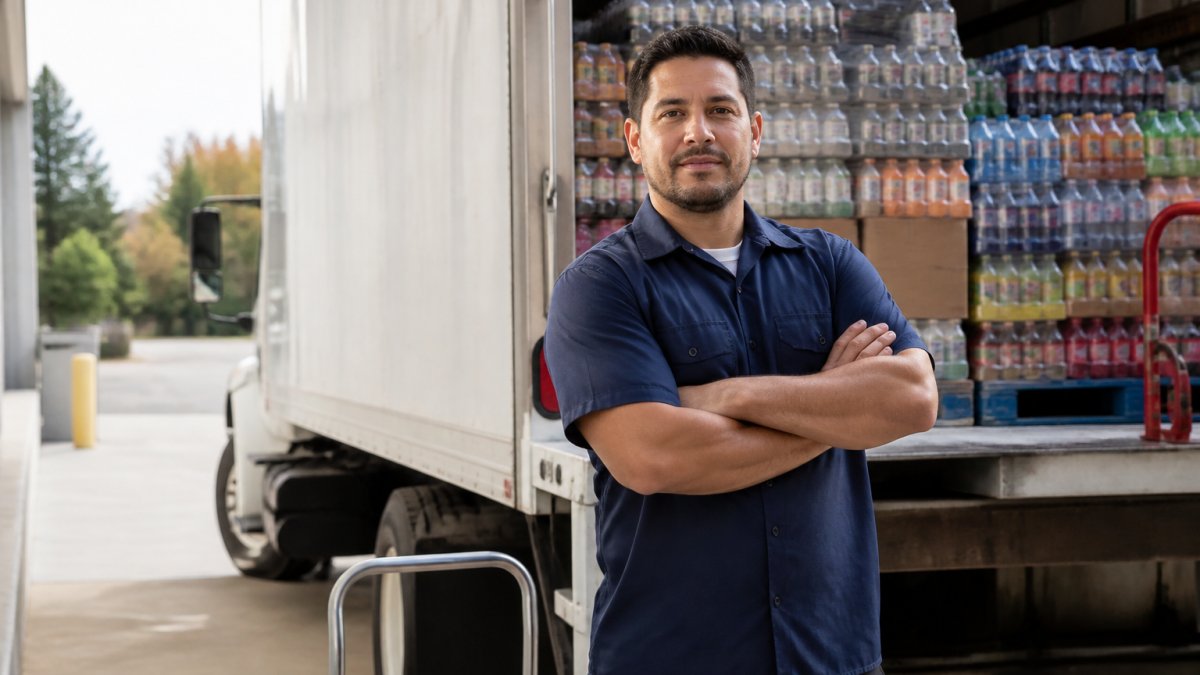
Route sales representatives do more than deliver. They build relationships with store managers, negotiate shelf placement, and keep planograms correct. Read the physical requirements of beverage delivery routes to understand the demands of the job.
The article lays out the five stages of a typical DSD cycle, which can be scanned as follows.
| Step | What happens | Who or what handles it |
|---|---|---|
| Order capture | Orders from store reorders, rep visits, or automated replenishment | Store, route rep, or system |
| Route planning | Stops sequenced to cover territory within driver hours | Route planning |
| Loading and dispatch | Product loaded in delivery order, first stop unloads first | Driver and loading crew |
| In-store delivery | Product brought in, stock rotated, expired items removed, shelf restocked | Driver |
| Proof of delivery | Store signs off on a handheld; payment or credit terms recorded | Store and driver |
Which Products and Industries Use Direct Store Delivery
DSD is most common where product freshness, short shelf life, or heavy shelf competition make frequent store visits worthwhile. The main categories are:
- Snack foods: Chips, cookies, and crackers, where stale product is a visible problem.
- Beverages: Soft drinks, bottled water, and some dairy, where bulk weight makes warehouse handling expensive.
- Bakery: Bread and pastries with short shelf lives.
- General merchandise: Items like greeting cards, batteries, and health and beauty products where a route rep manages a store's category.
Industries that rely on DSD typically share three traits: high unit velocity, many stores per supplier, and a need for in-store execution. If a product sells slowly, ships in shelf-stable cases, and has few store locations, a warehouse model is usually cheaper.
Direct Store Delivery Examples in Beverage, Snack, and Bakery Sales
Examples help show how the model works in practice. A regional snack brand might run a route that covers grocery stores, convenience stores, and gas stations within a 100-mile radius. Each visit replenishes chips and removes slow-moving flavors that the store manager has flagged. A bakery route might deliver fresh bread at dawn, pulling yesterday's unsold loaves off the shelf and replacing them the same morning.
Beverage routes often add a layer of complexity because bottles and cases are heavy and seasonal demand swings sharply. A driver may shift from carrying sparkling water in summer to holiday-specific packs in December, and the route plan has to absorb that change.
The pattern across all three is the same: frequent, small deliveries replace fewer large shipments, and the person making the delivery is also responsible for what the shelf looks like afterward.
Direct Store Delivery Advantages and Disadvantages for Suppliers and Retailers
Route accounting and DSD software categories
Direct Store Delivery vs Warehouse Distribution and Third-Party Distribution
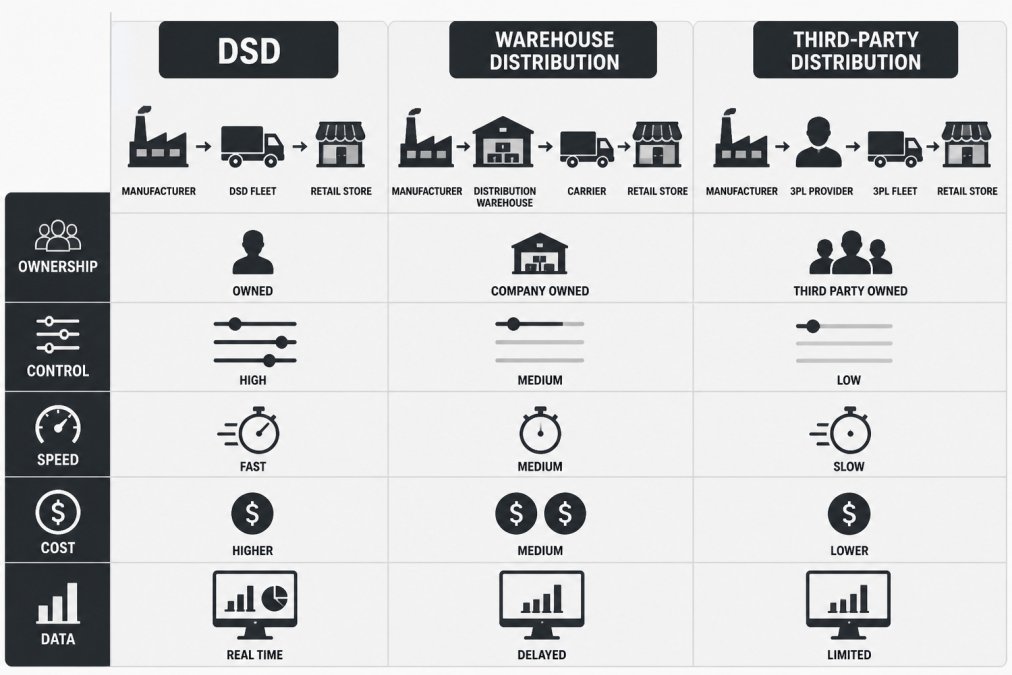
Most articles define DSD and stop. The more useful question is when DSD beats the alternatives. There are three common routes to the shelf, and they differ in who owns the inventory, who touches the store, and who absorbs the cost of a missed sale.
Warehouse distribution (DC model). The supplier ships pallets to a regional distribution center, and the retailer or a distributor moves product from the DC to stores. Inventory is centralized, truckloads are full, and the cost per case is low. The trade-off is time: a store order may take a day or more to arrive, and the supplier never sees the shelf. This model fits shelf-stable, slow-to-medium velocity products sold across many stores. Optimizing these centralized logistics flows remains a primary method for organizations to lower business restocking costs while maintaining the consistent availability required for high-volume retail environments.
Third-party distribution. A distributor buys or holds product and delivers to stores on the supplier's behalf. The supplier gets scale and store coverage without building a fleet, but gives up direct shelf control, real-time store data, and some margin. This is common for smaller brands that want broad coverage before they can justify their own routes.
Direct store delivery. The supplier's own route driver delivers, stocks, rotates, and often sells. The supplier controls execution and sees demand at the shelf, but pays for trucks, drivers, and route labor on every stop.
A practical comparison comes down to five levers:
- Ownership: DSD puts inventory and fleet cost on the supplier; the DC model pushes inventory toward the retailer or distributor; third-party distribution splits it.
- Control: DSD gives the supplier the most control over shelf placement, freshness, and display; the DC model gives the least.
- Speed to shelf: DSD is fastest for high-velocity items; DC delivery is slower but cheaper per case.
- Cost structure: DSD costs scale with the number of stops; DC costs scale with volume and pallet efficiency.
- Data: DSD produces store-level sell-through and shelf conditions; DC and third-party models produce order-level data at best.
A simple decision rule helps. If a product is perishable or fast-moving, sells in many stores per route, and wins sales through in-store execution, DSD usually pays for itself. If a product is shelf-stable, sells slowly, and ships efficiently in full cases, a warehouse or third-party model is usually cheaper. Many suppliers run a hybrid: DSD for top-velocity stores and accounts where shelf execution matters, and a distributor or DC for the long tail.
Direct Store Delivery Software and Tools for Route Management
Route management software typically handles route planning, order capture on handheld devices, proof of delivery, and inventory tracking by store. Common features include automatic stop sequencing, electronic signatures at delivery, and reporting on fill rate and on-time delivery.
When evaluating tools, check whether the software integrates with your order management and accounting systems, whether drivers can use it offline, and how quickly it recalculates routes when a store adds an unplanned order. Avoid choosing software based only on feature lists. Test it on one real route for two weeks before committing.
Planning Your Next Step Into a Direct Store Delivery Route Role
For anyone considering a career in DSD, the route is the core of the job. Route drivers and sales representatives manage a defined set of stores, build relationships with managers, and are measured on delivery accuracy, shelf execution, and sales on their route.
Start by identifying which product categories and regions you know best, then look for route openings in those categories. Our DSD Route Sales Connections job board lists route driver and sales representative positions from employers across the beverage, snack, bakery, and general merchandise sectors, so you can compare openings in one place. Browse the open route jobs on our site and check how each role describes its territory, schedule, and physical demands before you apply.
Frequently Asked Questions
What defines direct delivery?
Direct store delivery, often shortened to DSD, is a distribution model in which a manufacturer or supplier delivers products straight to individual retail stores instead of sending them through a central warehouse or distribution center first.
What are DSD vendors?
DSD vendors are the manufacturers, suppliers, or distributors that deliver their products directly to retail stores.
What are the advantages and disadvantages of direct store delivery?
The main advantages of direct store delivery are fresher products, tighter control over shelf stock and product availability, and a direct relationship between the supplier's sales team and the retailer. Route sales representatives can spot out-of-stocks and merchandising issues during each visit. The disadvantages include higher delivery costs per stop, the need to employ and manage a large route workforce and fleet, and less economy of scale than shipping full truckloads to a distribution center. Suppliers must also invest in route planning and delivery scheduling tools to keep costs under control.
How is direct store delivery different from warehouse distribution?
In warehouse distribution, products move from the manufacturer to a regional distribution center, then to retailer stores in bulk shipments managed by the retailer's logistics team. In direct store delivery, the supplier skips that step and delivers directly to each store.
Which products are commonly sold through direct store delivery?
Products most often sold through direct store delivery include bread and bakery goods, salty snacks, cookies, chips, soft drinks, bottled water, dairy items, and some frozen foods. These categories share traits that make DSD practical: short shelf lives, high turnover, and a need for frequent shelf restocking. General merchandise and some health and beauty items are also distributed this way in certain markets. Products that keep for months and move in large, predictable volumes usually go through distribution centers instead.