 how-to
Fastest Hiring Process for Delivery Drivers: 2026 Guide
Table of Contents
- Why a Fast Hiring Process for Delivery Drivers Matters Now
- How Long Does It Take to Get Hired as a Delivery Driver?
- Step 1: Build a Candidate Pipeline Before You Post the Job
- Step 2: Optimize Your Job Description for Speed and Clarity
- Step 3: Use Automated Background Checks for Drivers
- Step 4: simplify Interview Scheduling and Screening
- Step 5: Cut Time-to-Hire With a Delivery Driver Onboarding Checklist
- Common Mistakes That Slow Down Your Hiring
- Frequently Asked Questions
Last Updated: September 8, 2026
The cost of a vacant route can be measured in missed shelf placements, lost cold-chain integrity, and overworked existing staff. Yet many distributors still treat hiring as a week-long administrative chore. The fastest hiring process for delivery drivers can shrink from several weeks to under five days when employers build a repeatable system.
The fastest hiring process for delivery drivers is a sequence of deliberate steps: a pre-built candidate pipeline, a job description that filters for you, automated compliance checks, and a structured onboarding day. This guide breaks down that sequence into five actionable steps, plus the common mistakes that quietly double your time-to-hire.
Before you post a single job, understand the benchmark you are chasing. Most distribution and logistics roles move slower than they should because hiring managers treat each application as a unique event rather than part of a pipeline. The goal is to make the process from application to route-ready as close to five business days as possible.
Why a Fast Hiring Process for Delivery Drivers Matters Now
Delivery logistics runs on predictable capacity. When a driver gives notice, the route does not pause. Other drivers absorb the load, customer service slips, and your fleet management team scrambles. The cost of that scramble is far higher than the cost of moving faster in the hiring seat.
Speed also protects your candidate pool. Qualified drivers with a clean motor vehicle record and DSD experience rarely stay on the market long. The employer that responds within 48 hours with a clear next step usually wins; the one that waits a week loses the applicant to a competitor.
A fast process is also a quality signal. Drivers interpret a simplified hiring experience as a sign of operational efficiency. If your hiring process drags, they assume your dispatch and route planning do too. Speeding up recruitment automation and screening protects your reputation as an employer.
How Long Does It Take to Get Hired as a Delivery Driver?
A realistic target for the fastest hiring process for delivery drivers is five to seven business days from application to signed offer. But a target without stage-level benchmarks is just a wish. Most hiring teams do not track where time is lost, which is why their process drifts to 14 or 21 days.
Here is the benchmark breakdown that high-volume hiring teams use to hold each stage accountable:
| Stage | Benchmark (Business Days) | What Causes Delay |
|---|---|---|
| Application to screening decision | 0-1 | Manual resume review instead of automated pre-screening |
| Screening to interview scheduled | 0-1 | Back-and-forth email scheduling |
| Interview to selection | 1 | Multiple interview rounds for a route role |
| Selection to conditional offer | 0-1 | Waiting for full background check before extending offer |
| Conditional offer to signed offer | 2-3 | Motor vehicle record (MVR) turnaround from the state DMV |
| Signed offer to route-ready | 3-5 | Onboarding tasks run in sequence instead of parallel |
A common pattern is that the MVR check alone consumes 40% of the total timeline (peer-reviewed research). State DMV portals return MVR results in 24 to 72 hours in most states, but only if the request is submitted electronically with the correct driver license number and date of birth (aamva.org). A single typo resets the clock. Batching MVR requests at the end of the week loses two weekend days.
Candidate drop-off is the hidden cost that never appears on a hiring dashboard. Recruiters report that 30% to 40% of candidates disappear between application and interview when the process requires more than one business day of silence (shrm.org). The drop-off is worse for currently employed drivers, a process requiring three separate in-person appointments will lose more than half of the qualified pool.
The fastest hiring process for delivery drivers is about measuring each stage so you know which step is the bottleneck. The five-to-seven-day target is achievable only when the MVR check runs in parallel with the interview. Teams that run the MVR check on day one consistently report a two-day reduction in total time-to-hire.
A second benchmark worth tracking is the offer acceptance rate. If a candidate takes more than 48 hours to respond, they are likely waiting on a competing offer. Top-performing teams extend offers with a 48-hour expiration and a clear statement of the start date. Candidates who want the role will sign quickly; those using your offer as leverage will not.
Step 1: Build a Candidate Pipeline Before You Post the Job
The fastest hiring process for delivery drivers starts before the job is even open. If you only start sourcing when a driver resigns, you are already behind. A pre-built candidate pipeline means you have a pool of vetted, interested drivers ready the moment a route opens.
Building that pipeline takes consistent effort. Collect applications even when you have no open positions, keep a database of past applicants, and stay in touch with former drivers who left on good terms. These warm candidates skip the entire sourcing phase.
Posting to a specialized job portal for DSD professionals, rather than a general board, also shortens the application funnel. General boards attract applicants without route experience or a valid CDL, forcing you to screen out most of the volume.
Step 2: Optimize Your Job Description for Speed and Clarity
Your job description is a screening tool. A vague posting attracts hundreds of unqualified applicants. A precise one attracts fewer, better-matched drivers and reduces your screening workload.
Write the posting to answer the questions a good driver actually asks. State the route territory, the start time, the expected daily stops, and the vehicle type. Be explicit about physical demands and license requirements. Drivers who know the reality before applying are less likely to quit during the first 90 days.
A clear job description also accelerates candidate engagement. When applicants see exactly what the role involves, they self-select, so your interview scheduling time is spent on serious candidates rather than tire-kickers.
Step 3: Use Automated Background Checks for Drivers
Manual background check requests are the single biggest drag on hiring velocity. The fastest hiring process for delivery drivers depends on automated background checks for drivers, which submit the request the moment a candidate passes screening.
Automated background checks for drivers typically cover three core areas: the motor vehicle record, a criminal history search, and employment verification. The MVR confirms the candidate can legally operate your vehicles, the criminal history search addresses safety and liability, and employment verification confirms the DSD experience listed on their resume.
Set your screening criteria before you post the job. Decide which violations are disqualifying and which are acceptable. A single minor infraction from years ago may not matter for a local route, but a recent DUI absolutely does. Document these criteria so the process is consistent and defensible.
Step 4: simplify Interview Scheduling and Screening
Interview scheduling is where most hiring processes lose two to three days. Use scheduling software that shows your available slots and lets the candidate pick one, or block out dedicated interview windows each week.
But the real speed gain is not in the calendar, it is in what happens before the interview. The fastest hiring process for delivery drivers uses automated screening to eliminate the manual review queue entirely. Here is the blueprint that high-volume hiring teams use:
Step 1: Build a knockout question set into your application form. Before the candidate ever reaches a human, the system should reject applications that fail three non-negotiable criteria: a valid driver's license, a clean enough MVR to pass your documented threshold, and verifiable delivery or DSD experience within the last 24 months. Most applicant tracking systems (ATS) support conditional logic that hides the rest of the application if a candidate fails a knockout question. This single step cuts application volume by 50% to 70%.
Step 2: Use a text-based pre-screening conversation. Instead of a phone screen, send a short SMS questionnaire that asks three scenario questions, such as "A store receiver says you delivered 10 cases short of the invoice. What do you do?" Candidates respond in under five minutes from their phone, and the responses are logged in your ATS. This replaces the 15-minute phone call that requires both parties to be available at the same time.
Step 3: Automate the interview slot offer. When a candidate passes the text screen, the system immediately sends a link to your open interview slots for the next two days. No human touches the scheduling. Candidates who do not book within 24 hours are unlikely to accept a job that requires early morning starts, let them self-select out.
Step 4: Run the MVR check before the interview, not after. This is the single highest-leverage automation in the entire process. Submit the MVR request the moment the candidate passes the text screen. By the time the interview happens, you already know whether the candidate is legally eligible to drive your vehicles, converting the interview from a compliance gamble into a conversation about route experience and customer fit.
For the interview itself, structure it for speed. A 30-minute focused conversation beats a 60-minute rambling one. Ask about the candidate's specific route experience, their comfort with early morning start times, and their reason for leaving their last role.
Consider a pre-employment assessment for the non-driving skills. A short questionnaire about handling delivery exceptions, damaged product, or customer complaints reveals more about a candidate's judgment than a general conversation and filters out those who lack the field sales mindset DSD routes require.
The automation blueprint above is the standard configuration in modern ATS platforms that support API-driven screening. The key is that every step runs in parallel, not in sequence. While the MVR check is processing, the candidate is completing the text screen. While the candidate is in the interview, the background check vendor is already working on employment verification. The manual alternative is why most hiring processes take three weeks instead of five days.
Step 5: Cut Time-to-Hire With a Delivery Driver Onboarding Checklist
A delivery driver onboarding checklist is the bridge between a signed offer and a driver who is productive on a route. The fastest hiring process for delivery drivers does not end at the offer letter. It ends when the new hire completes their first solo route without supervision.
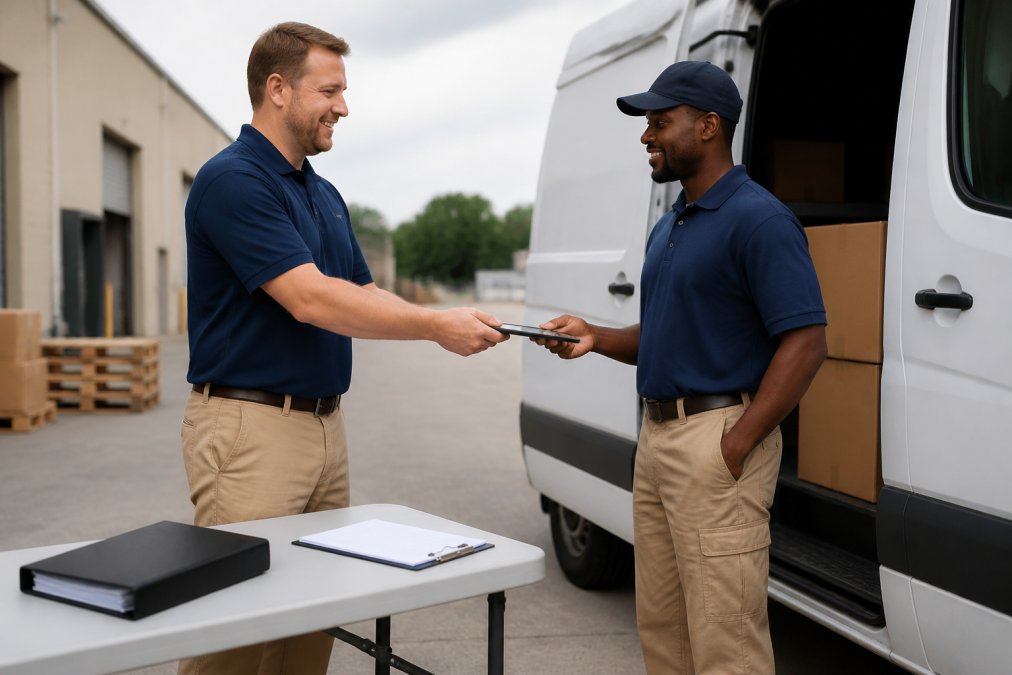
A delivery driver onboarding checklist should cover every compliance and training requirement in a single document. Core items include verifying the driver's license and certification, completing DOT-required paperwork if vehicles weigh over 10,001 pounds, assigning the vehicle and route equipment, and scheduling ride-along training.
The onboarding workflow does not have to happen all on day one. Split it into two phases: phase one covers paperwork and compliance items that must be done before the driver can operate a vehicle; phase two covers route-specific training, such as store protocols and product handling, over the first week.
| Onboarding Task | Responsible Party | Timing |
|---|---|---|
| Verify license and driver certification | HR or hiring manager | Before start date |
| Submit DOT and employment verification paperwork | HR | Day 1 |
| Motor vehicle record final check | HR | Day 1 |
| Vehicle assignment and safety orientation | Fleet manager | Day 1 |
| Ride-along with experienced driver | Route supervisor | Days 2-3 |
| Solo route with check-in calls | Route supervisor | Day 4-5 |
Common Mistakes That Slow Down Your Hiring
The most common mistake is treating every hire as a unique project. Without a documented process, each new opening starts from scratch, and hiring velocity depends on whoever happens to be managing the role that week. A standardized process with clear owner for each step removes that variance.
A second mistake is over-screening on the first pass. Requiring a perfect employment history or rejecting candidates for minor gaps eliminates qualified drivers. Focus on the factors that actually predict success: a clean motor vehicle record, verifiable DSD experience, and a stable work history.
A third mistake is ignoring the driver-side perspective on friction. Candidates drop out of processes that feel disrespectful of their time. A process requiring three separate interviews, a physical test on a separate day, and a drug screening 30 miles away will lose candidates. Compress the steps, co-locate the testing, and respect that your candidates are often currently employed.
Building the fastest hiring process for delivery drivers is about removing friction at every stage, from the job posting to the onboarding checklist. Distributors who compress their time-to-hire win the competition for qualified route drivers and keep their delivery logistics running without interruption. DSD Route Sales Connections supports this effort by connecting employers directly with experienced route sales professionals through a direct application process with no middlemen, nationwide coverage, and a platform built exclusively for the DSD sector. Get started with DSD Route Sales Connections and find qualified talent fast.
Frequently Asked Questions
What is the fastest way to hire delivery drivers?
The fastest delivery driver hiring process combines a pre-built candidate pipeline, automated screening, and same-day interview scheduling. Posting to a specialized DSD job board reaches qualified candidates directly. Automate motor vehicle record checks and background screening to avoid manual delays. Prepare a standardized onboarding checklist so paperwork is done before the start date. This approach can cut time-to-hire from several weeks to under five business days.
How long does it take to get hired as a delivery driver?
Typical time-to-hire for delivery drivers ranges from 1 to 3 weeks. Employers who rely on manual resume reviews and in-person paperwork add days to each step. Companies using automated background checks for drivers and digital onboarding can complete the process in 3 to 5 days. Your own timeline depends on how quickly you complete the motor vehicle record check and drug test, which are often the longest steps.
What should be on a delivery driver onboarding checklist?
A delivery driver onboarding checklist should cover DOT compliance paperwork, motor vehicle record authorization, drug test scheduling, and I-9 verification before day one. Include a road test or driving evaluation, route familiarization, and training on your delivery app or handheld scanner. Confirm the driver has the required license class and medical card. Completing these steps before the start date lets new hires focus on route training instead of administrative tasks.
Are automated background checks for drivers reliable?
Yes, automated background checks for drivers are reliable when you use a provider that pulls directly from the FMCSA and state databases. Automation reduces human error and returns results in hours rather than days. You still need a designated person to review adverse findings. Automated screening handles the data collection and flagging, but final hiring decisions require human judgment, especially for compliance standards around safety and DOT regulations.