 how-to
5 Steps to Hire DSD Talent Without Third-Party Recruiters
Last Updated: October 24, 2026
Quick Summary
To hire DSD talent without third-party recruiters, define your specific role needs, post on DSD-focused job boards and LinkedIn, source candidates directly through industry groups and referral programs, and screen using route-specific interview questions. Direct hiring cuts recruiter fees of 15-25% of first-year salary while giving you control over timeline and candidate experience.
- Third-party recruiters typically charge 15-25% of first-year salary; a $55,000 role costs $11,000 per hire.
- Build a candidate pipeline from LinkedIn groups, industry forums, Facebook driver communities, and employee referrals before posting.
- Use a three-touch outreach sequence spaced 3-4 days apart: personalized opener, value-add follow-up, and clean close.
- Screen with route-specific questions about time management, difficult customers, and early morning availability, then verify references.
- Block weekly recruiting time: 45 minutes Monday for applications, 60 minutes Tuesday for phone screens, 90 minutes Thursday for interviews.
Table of Contents
- Why Direct Hiring for DSD Talent Makes Sense
- Step 1: Define Your DSD Hiring Needs and Build a Candidate Pipeline
- Step 2: Create an Effective DSD Job Posting Template
- Step 3: Source Candidates Through Direct Channels
- Channel 1: LinkedIn (best for route sales reps and account managers)
- Channel 2: Industry job boards and DSD-specific communities
- Channel 3: Facebook and regional driver groups
- Channel 4: Referral bonuses
- Channel 5: CDL schools and workforce programs
- The outreach sequence that works
- Compliance guardrails for direct outreach
- Measure each channel
- Step 4: Screen and Interview Using Route Driver Interview Questions
- In-House Recruiting Strategies for DSD Route Sales Positions
- How to Hire DSD Drivers and Build Long-Term Talent Retention
- Start Recruiting DSD Talent on Your Timeline
- Frequently Asked Questions
Why Direct Hiring for DSD Talent Makes Sense
Direct Store Delivery hiring doesn't have to mean paying recruiter fees.
Traditional recruiting costs money: recruiters take a cut, you wait weeks, and good candidates slip away.
We've seen operations teams cut their hiring costs by building their own pipelines.
Experienced DSD professionals want stable work.
Avoiding recruiter fees for DSD hiring is the core motivation.
Step 1: Define Your DSD Hiring Needs and Build a Candidate Pipeline
Before you post anything, get specific about what you need.
Start here:
- Route type: Beverage, snack, bakery, general merchandise, or mixed?
- Territory: Urban, suburban, rural, or multi-area?
- Physical demands: How much lifting, climbing, or standing per day?
Once the role is clear, build your candidate pipeline, a list of people who might be interested.
Where do experienced DSD professionals hang out?
- LinkedIn groups for route sales and delivery drivers
- Industry forums and Facebook groups for beverage and snack distributors
- Local trucking associations and CDL driver communities
Start collecting names and contact info now. When you're ready to hire, you already have warm leads.
LinkedIn Recruiter resources for direct sourcing show that passive candidates often respond better to personalized outreach than public job postings.
Step 2: Create an Effective DSD Job Posting Template
Your job posting is your first impression. A good posting answers the questions candidates actually ask:
- What will I do every day?
- How much will I make?
- What hours are we talking?
Here's a template you can adapt:
[Your Company] is hiring DSD Route Drivers for [Territory/Region]
We're looking for experienced route drivers and sales reps to join our team.
The Role:
- Deliver and stock products at retail locations
- Build relationships with store managers and owners
- Meet daily/weekly sales targets
What We Need:
- 2+ years DSD or delivery experience
- Valid CDL (or willingness to get one)
- Reliable transportation
What You Get:
- Base salary: [AMOUNT] or commission structure: [DETAILS]
- [Vehicle provided / vehicle allowance]
- [Health insurance / benefits details]
To Apply: Apply directly via DSD Route Sales Connections or email [your contact] with:
- Your resume
- 2 references from previous DSD roles
- Availability start date
Keep it honest. Vague postings attract tire-kickers; specific ones attract serious candidates.
Society for Human Resource Management guidelines on job descriptions emphasize that clear role definitions reduce turnover and speed hiring. Spend 30 minutes getting this right.
Step 3: Source Candidates Through Direct Channels
Posting alone isn't enough, direct sourcing means contacting candidates before they apply. Recruiters wait for applications; you go find people.
Most pages stop at "post on job boards and use LinkedIn", that is not a sourcing plan. A real plan assigns each channel a role, a weekly time budget, a message sequence, and a way to measure interviews produced.
Channel 1: LinkedIn (best for route sales reps and account managers)
Use LinkedIn for the sales side of DSD, route sales representatives, account managers, and merchandising leads, not for drivers who rarely maintain profiles.
- Search strings to save:
"route sales" AND (beverage OR snack OR bakery),"DSD" AND "direct store delivery","account manager" AND (grocery OR convenience). - Filters: location radius of 25-50 miles, current title, and "open to work" where visible.
- Time budget: 30-45 minutes, three times per week.
Channel 2: Industry job boards and DSD-specific communities
DSD Route Sales Connections reaches route drivers and sales reps actively looking for DSD work. Post the role, browse candidate profiles, and check messages daily during an active search.
Channel 3: Facebook and regional driver groups
Search for groups such as "Beverage Route Drivers," "Snack Delivery Jobs," and state-level "CDL Drivers" groups. Join, read the rules, and engage for a week before posting, many restrict job posts to specific days, and violating that costs you the channel. Consistent participation establishes your credibility within these communities, ensuring that your future posting job openings reach a receptive audience rather than being dismissed as spam.
Channel 4: Referral bonuses
Offer current employees a referral bonus, a common range is $500-$1,000 paid after the referred hire stays 90 days. Referrals onboard faster and stay longer. Announce the bonus at shift start and put it in writing.
Channel 5: CDL schools and workforce programs
New CDL holders and career-switchers are motivated and often overlooked. Contact local CDL schools, state workforce centers, and community college workforce programs; ask to be added to their employer list and to speak at a graduating class. Slower, but these candidates have no competing offers.
The outreach sequence that works
One message is not outreach; it is a coin flip.
Touch 1, personalized opener (Day 0):
Hi [Name], I saw your experience managing [beverage/snack] routes in [area].
Touch 2, value add (Day 3-4):
Hi [Name], following up briefly.
Touch 3, clean close (Day 7-8):
Hi [Name], I'll stop reaching out after this.
Log who you contacted, when, and which touch they received, without it you'll double-message people and lose credibility.
Compliance guardrails for direct outreach
Direct sourcing still has rules:
- Consistent criteria. Apply the same minimum qualifications to every candidate you contact so you can defend selection decisions.
- No protected-characteristic questions. Do not ask about age, family status, health, disability, or national origin in messages or calls. The Equal Employment Opportunity Commission (EEOC) enforces federal anti-discrimination law, and state agencies may add requirements.
- Accurate pay information. Several states and cities require pay range disclosure in job postings; check your state's rules before posting a range or omitting one.
Measure each channel
After four weeks, count interviews scheduled per channel. Usually one or two channels produce most of your interviews. Double the time on those and drop the rest. This is the discipline third-party recruiters apply, and the reason you can replace them.
Step 4: Screen and Interview Using Route Driver Interview Questions
Not every candidate is right for DSD work. Screening fast saves time.
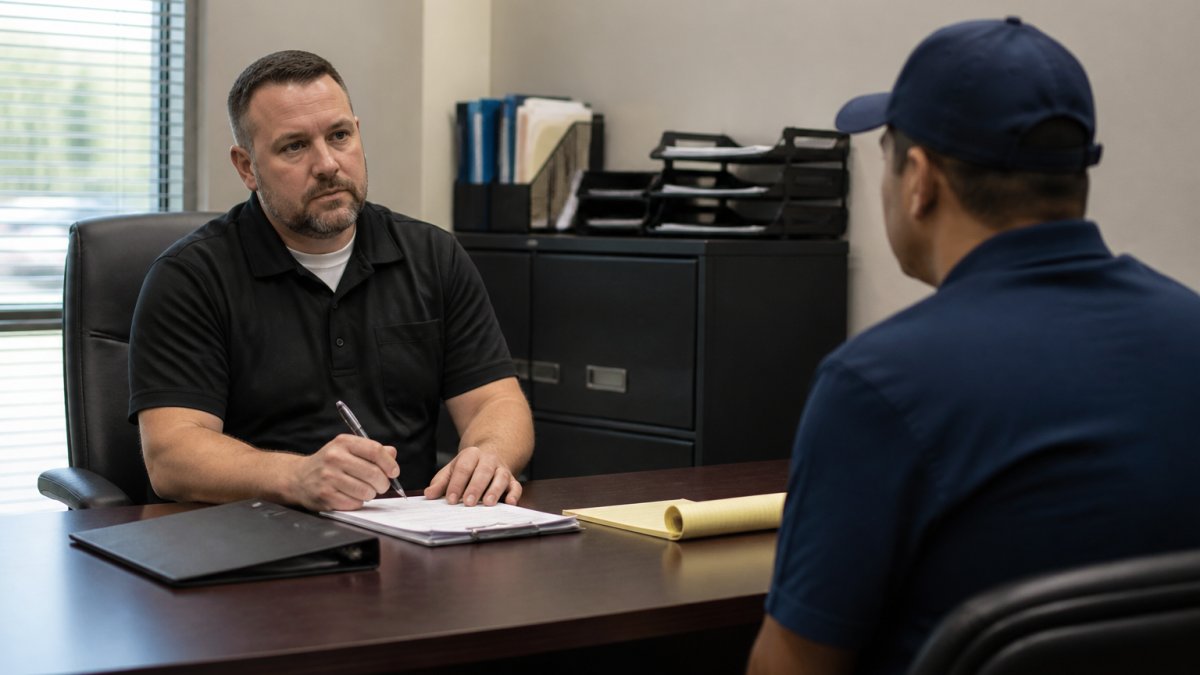
Phone screen first. This takes 10-15 minutes. Ask:
- "Walk me through your last route job. What did you like? What was hard?"
- "Why are you looking to move?"
- "What's your CDL status?" (If needed)
This filters out people who aren't serious. Move serious candidates to an in-person interview.
In-person interview questions for DSD roles:
- "Describe a time you missed a delivery target. What happened?"
- "How do you manage your time when you have 50 stops in one day?"
- "Tell me about a difficult customer interaction. How did you handle it?"
Ask about their last role, employment gaps, and what they're looking for.
Watch for:
- Reliability (do they show up on time to the interview?)
- Attitude toward customers (do they respect retail staff?)
- Honesty about challenges (do they own mistakes?)
Check references. Call their last manager or supervisor. Ask: "Would you rehire this person?
In-House Recruiting Strategies for DSD Route Sales Positions
Building an in-house recruiting process means you own it, no middleman, no surprises. Recruiting for Small DSD Distributors: A Step-by-Step Guide walks you through each stage of implementation. But that only pays off if the process is specific enough to run without a recruiter. Here is what that looks like for DSD route sales roles, plus the cost math.
The cost comparison: in-house vs. third-party recruiter
A third-party recruiter typically charges a percentage of first-year salary, commonly 15-25% for placement, sometimes with a retained or flat-fee structure. On a $55,000 route sales base, a 20% fee is $11,000 per hire. Hire three people a year and you have spent $33,000 before the first route is run.
In-house direct hiring shifts that cost into time and tools:
- Job board posting: often free or low-cost on DSD-specific boards; general boards may charge per posting.
- Your time: budget 8-15 hours per hire for sourcing, screening, and scheduling.
- Referral bonuses: $500-$1,000 per successful referral, paid after 90 days.
The trade-off is real: recruiters bring reach and speed you may lack on day one.
The weekly operating rhythm
A process only works if it runs on a schedule. Block these windows on your calendar:
| Day | Task | Time |
|---|---|---|
| Monday | Review new applications; send first-touch messages | 45 min |
| Tuesday | Phone screens | 60 min |
| Wednesday | Follow-up messages; update tracking sheet | 30 min |
| Thursday | In-person or ride-along interviews | 90 min |
| Friday | Reference checks; offers; candidate follow-ups | 45 min |
Tracking that actually gets used
Use a spreadsheet or basic CRM (Google Sheets works) tracking name, contact info, source, status, notes, and next follow-up date. The most important column is the follow-up date, most lost candidates are lost to silence, not competitors.
Response and decision timelines
- Application acknowledgment: within 24 hours.
- Phone screen: within 2 days of application.
- In-person or ride-along interview: within 5 days.
Candidates respect speed. A slow process signals a disorganized route, and experienced DSD candidates have seen enough of those.
DSD-specific screening mechanics
Generic interview advice does not fit route work. Add these mechanics to your process:
- Driving record and CDL verification. Confirm license class and endorsements, and review the motor vehicle record through a compliant vendor. Do this after a conditional offer.
- Physical capacity conversation. Describe the actual lifting, climbing, and standing requirements and ask the candidate to confirm they can perform them with or without reasonable accommodation. Do not ask about health or disability.
- Route math exercise. Give a short scenario: 40 stops, a two-hour delivery window, one store with a receiving backlog. Ask how they would sequence the day. This reveals planning ability better than any interview question.
The offer and first 30 days
Use a simple offer letter stating start date, base salary or commission structure, benefits, reporting structure, and first-day logistics. Then run a written onboarding plan:
- Day 1: paperwork, orientation, meet the team, vehicle and equipment assignment.
- Week 1: ride-along with an experienced driver or manager.
- Week 2-4: supervised route with daily check-ins.
Keep near-misses warm
Candidates you didn't hire this time may fit the next opening. Keep their information, note why they weren't selected, and reach out when a route opens, this pipeline makes your second and third hires much faster than the first.
How to Hire DSD Drivers and Build Long-Term Talent Retention
Hiring is one thing. Keeping people is another.
DSD work is physical and demanding. Early mornings, heavy lifting, weather, traffic.
Here's how to keep them:
Pay competitively. Check what other distributors in your area pay.
Offer stability. Consistent routes, predictable schedules, and clear expectations reduce turnover.
Listen to feedback. Ask drivers what's working and what's not.
Safety and compliance matter. Ensure DOT compliance, proper training, and safe practices.
Start Recruiting DSD Talent on Your Timeline
You don't need a recruiter to build a strong DSD team.
Define your needs. Post where DSD professionals actually look. Source actively.
When you own the process, you control the timeline and the cost.
Start with one open position. Build your system. Refine it. Then scale.
Ready to post your first DSD job opening?
Frequently Asked Questions
What is the most effective way to hire DSD talent without third-party recruiters?
Build a direct sourcing strategy by posting on specialized DSD job boards, leveraging your existing network, and using social media to reach route drivers and sales representatives. Screen candidates using role-specific interview questions that assess DSD experience, reliability, and customer-facing skills. Many employers find that combining a strong DSD job posting template with direct outreach to passive candidates significantly reduces hiring time and cost compared to agency fees.
How should I structure a DSD job posting template to attract qualified candidates?
Include the specific route territory, compensation structure (base salary, commission, bonuses), vehicle requirements, and key responsibilities. Highlight stability, schedule predictability, and growth opportunities. Clearly state required qualifications: valid CDL, clean driving record, industry experience, and customer service skills. Be transparent about early start times and physical demands. Use language that resonates with experienced route drivers, mention flexibility, independence, and earning potential. A well-crafted posting reduces unqualified applicants and speeds up the hiring process.
What route driver interview questions should I ask to assess DSD experience?
Ask about previous route management experience, territory size they've handled, customer retention strategies, and how they handled challenging delivery situations. Inquire about their approach to time management on early morning routes and vehicle maintenance responsibility. Ask for specific examples of how they increased sales or reduced delivery time. Request references from former employers or customers. These questions reveal whether candidates understand DSD operations, can manage independence, and have a track record of success in similar roles.
How long does it typically take to hire DSD talent using in-house recruiting strategies?
Direct hiring timelines vary based on your candidate pool and role specificity. Building a pre-screened candidate pipeline accelerates the process further. The speed depends on how clearly you define the role, how targeted your sourcing channels are, and how quickly you move through screening and interviews. Starting with a strong DSD job posting template and multiple sourcing channels typically yields results faster than waiting for recruiter submissions.
Direct hiring works because it's simple, fast, and honest. You post a real job. Real candidates apply. You hire the best fit. That's the whole system. Build it once, and you'll use it for years.